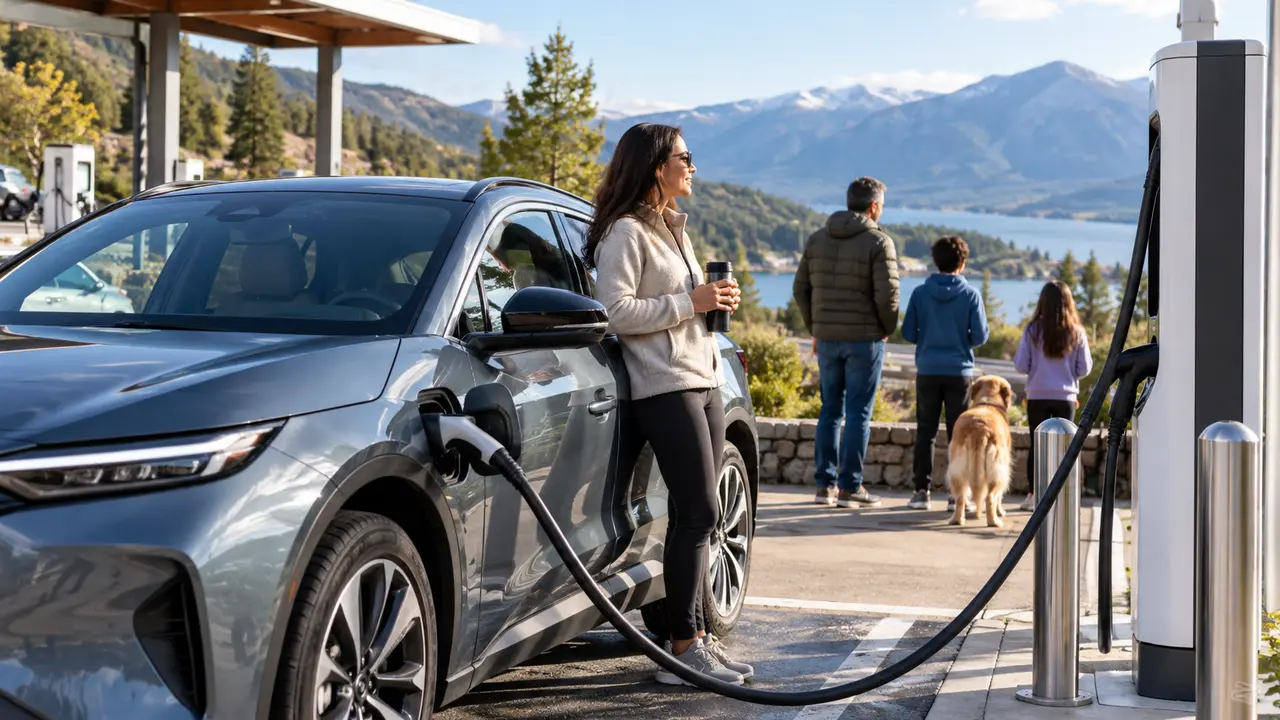
EV Road Trip Charging Guide 2026: Plan Stops, Costs and Backups
Plan the charging stops before you choose the route
An electric car road trip becomes much easier when you plan around the stops you would make anyway. Start with the distance, your car’s real highway range, the weather, and the people travelling with you. A charger near a meal stop may be more useful than a faster unit far from food and restrooms. The aim is not to find the fewest stops. It is to reach each stop with a safe amount of energy and leave enough room for delays.
Do not use the range shown on the dashboard as a promise. That number can change with speed, hills, rain, wind, cabin heating, and luggage. A car that covers a familiar commute with ease may use more energy on a fast motorway. If you are new to long journeys, plan the first charging stop early. You will learn the car’s real use before you commit to a longer stretch.
Use a realistic arrival buffer
A practical first plan is to reach a charger with roughly 15% to 25% battery remaining, then adjust for local conditions and the car’s guidance. This is a planning margin, not a universal safety rule. Choose a larger buffer where stations are scarce, the road climbs, or the weather is poor. A smaller buffer may work on a busy corridor with several proven stations, but there is little reward in arriving in a stressful state.
Check the charger, not just the map pin
A charging map may show a station even when a connector is broken, a payment method fails, or a car park is closed. Open the station details. Check the connector type, maximum charging power, access hours, recent driver reports, price structure, and whether a mobile app or card is required. Save a second site within reach. If a network posts live status, read it shortly before you leave and again on approach.
The public network is growing. The International Energy Agency reported more than seven million public charging points worldwide by the end of 2025. That is useful context, but national coverage is uneven. A large global number does not tell you whether the next station on a rural road works today. Local checks still matter more than headlines.
Match the plug and the car
Cars and chargers use several standards across the world. CCS, NACS, CHAdeMO, Type 2, and GB/T serve different markets and charging modes. A plug that looks similar may not support the charge you need. Use the vehicle manual and charger operator’s compatibility information. If you plan to use an adapter, check that the car and adapter makers approve that exact use. Never force a connection or depend on an unknown third-party adapter.

Understand the speed you can actually get
A charger advertised at 350 kW does not give every car 350 kW. Your vehicle sets a maximum rate, and the rate changes as its battery fills. Temperature, state of charge, station sharing, and battery preparation can all affect the result. Some cars warm or cool the battery when you navigate to a fast charger. Check whether yours needs an in-car navigation destination for that feature to work.
Fast charging is often quickest in the lower and middle part of the battery range. Charging from a low level to around 70% or 80% may take less time per added kilometre than waiting for the last 20%. Look at the route rather than any fixed percentage. If the next stop is close, a shorter session can be enough. If the next open charger is far away, take the extra energy. The right choice changes with the road.
Compare total stop time
Suppose one station offers 150 kW and a cafe, while another offers 300 kW but requires a long detour. If your car peaks at 120 kW, the second station may not help at all. Count the driving detour, the wait to connect, the likely battery charging curve, and the time you already want to rest. A slower charger at the right location can produce a faster and calmer trip overall.
Build a two-stop fallback plan
For every critical charging stop, mark a backup that your current battery can reach. Save the station name and access details offline. Avoid placing the only backup beyond the charger you are trying to reach. Where coverage is thin, check two separate providers if possible. This reduces the chance that one app outage or network issue will disrupt every option. Tell passengers about the plan before the trip, especially when travelling with children or older adults.
If the first charger is busy or fails, do not spend your entire reserve trying repeated sessions. Follow the screen’s safe troubleshooting steps, call the operator if a number is listed, and move to your backup while you still have range. If a connector seems damaged, stop and report it. Safety and a reliable route matter more than recovering a few minutes at a faulty unit.

Make payment work before departure
Charging payment differs by network and country. Some stations accept contactless cards. Others need a mobile app, an account, or roaming access through another provider. Install only the apps you expect to need and confirm the account and payment method at home. For cross-border trips, check whether the same account works after you cross the border. Bank fraud controls, phone coverage, and regional app restrictions can surprise travellers.
Read how the operator charges. The bill may depend on energy in kWh, time at the connector, parking time, or a combination. Some networks add an idle fee after charging ends. A station with a low energy price can cost more if you leave the car connected during a long meal. Check the receipt after each stop and keep a record if an amount looks wrong. Avoid assuming that a price shown in one currency or tax area will apply everywhere.
Drive in a way that protects your margin
At higher speeds, air resistance rises and the battery may drain faster than expected. Strong headwinds and cold weather can add to that effect. If the car predicts a tight arrival, reducing speed within the safe traffic flow is often more useful than turning off every comfort feature. Keep the tyres at the pressure specified on the vehicle placard when cold, not the maximum moulded on the tyre sidewall. Carry the right charging cable where a destination unit requires one.
Rain, heat and winter conditions need separate planning. Heating can draw battery power, while very cold batteries may charge slowly until conditioned. On hot days, thermal systems may also run harder. Use the vehicle’s range and route tools, but treat estimates as live guidance rather than fixed facts. Recheck after a climb, a long high-speed section, or an unexpected detour.

A practical 600 km route example
Imagine a family plans a 600 km journey in an EV that normally travels about 320 km on the motorway from a full charge in mild weather. They leave at 90%, aim for a first charging stop after roughly 200 km, and check two stations near a lunch area. They choose a second stop only if the remaining distance and weather require it. The exact numbers are examples, not a promise for any car. The useful habit is recalculating after each leg.
Before leaving, they save two charging networks, a backup stop, and the vehicle’s roadside assistance details. At the first stop, they charge only enough to reach the next planned point with a comfortable margin. One adult checks the operator’s live status while the other gets food. If the first charger is occupied, the family already knows the alternate location. That small amount of work turns an uncertain journey into a manageable sequence.
Five checks on the morning of travel
- Confirm tyre pressure and the condition of the tyres.
- Open the route and check the current weather.
- Check the live status of the key charging stops.
- Confirm payment methods and cable or adapter needs.
- Save backup stops and roadside help details.
What to do if charging does not start
First read the message on the car and station screen. A session may need the app to start before the plug is inserted, or the reverse. Follow the network’s exact instructions. Check whether the connector has locked into place, whether the car has a charging schedule that blocks the session, and whether the account has a valid payment method. If safe and allowed, end the session and try again once. Never touch damaged pins or exposed electrical parts.
If the station remains unavailable, contact its operator and move to the backup. Record the station ID, time, and error for a payment dispute. Do not run the battery down while arguing with the app. When range is critically low and no charger is reachable, use roadside assistance rather than risking a complete stop in traffic. The cost of help is small compared with the risk of stopping in an unsafe place.

The best plan stays flexible
A good EV road-trip plan is a set of choices, not a fixed script. Route planners and charging networks are useful, but they cannot predict every queue, weather shift, or closed car park. Give yourself a reserve, choose dependable stops, and know the next option before you arrive. With a little preparation, charging becomes part of a normal travel break rather than the main event of the day.
For a deeper look at connector standards, see our guide to EV charging connectors. For context on public charging growth, read the International Energy Agency’s Global EV Outlook 2026. Those sources help with the big picture. Your own route still needs up-to-date station checks.


One Comment